By Abhinav Jain, Founder – The Heal Company
Heal Better. Feel Better
One question we get at The Heal Company is:
“Can using a sitz bath cause an infection?”
It is a fair question. A sitz bath is used around a sensitive part of the body, and the same basin may be used again and again.
I am Abhinav Jain, founder of The Heal Company along with Deepika Jain. While developing The Heal Company – Sitz Bath Tub Manual, we have spent a lot of time thinking about something that doesnt get enough attention — hygiene.
Here is the simple answer:
A sitz bath itself is not meant to cause an infection. Keeping the area clean is actually one reason sitz baths are used in some medical-care settings. But poor hygiene, a dirty basin, contaminated water, or incorrect use can create unnecessary risk. Medical guidance also stresses keeping the bathing equipment and affected area clean and dry.
So lets talk about where the risk can come from.
What Is a Sitz Bath?
A sitz bath is a shallow warm-water bath used for cleansing or comfort around the lower pelvic and perineal area. It is commonly used after certain procedures and for problems such as hemorrhoid discomfort.
A portable sitz bath normally sits over a compatible Western toilet.
You fill the basin with comfortably warm water and sit over it for the recommended time.
Simple.
But simple doesnt mean hygiene should be ignored.
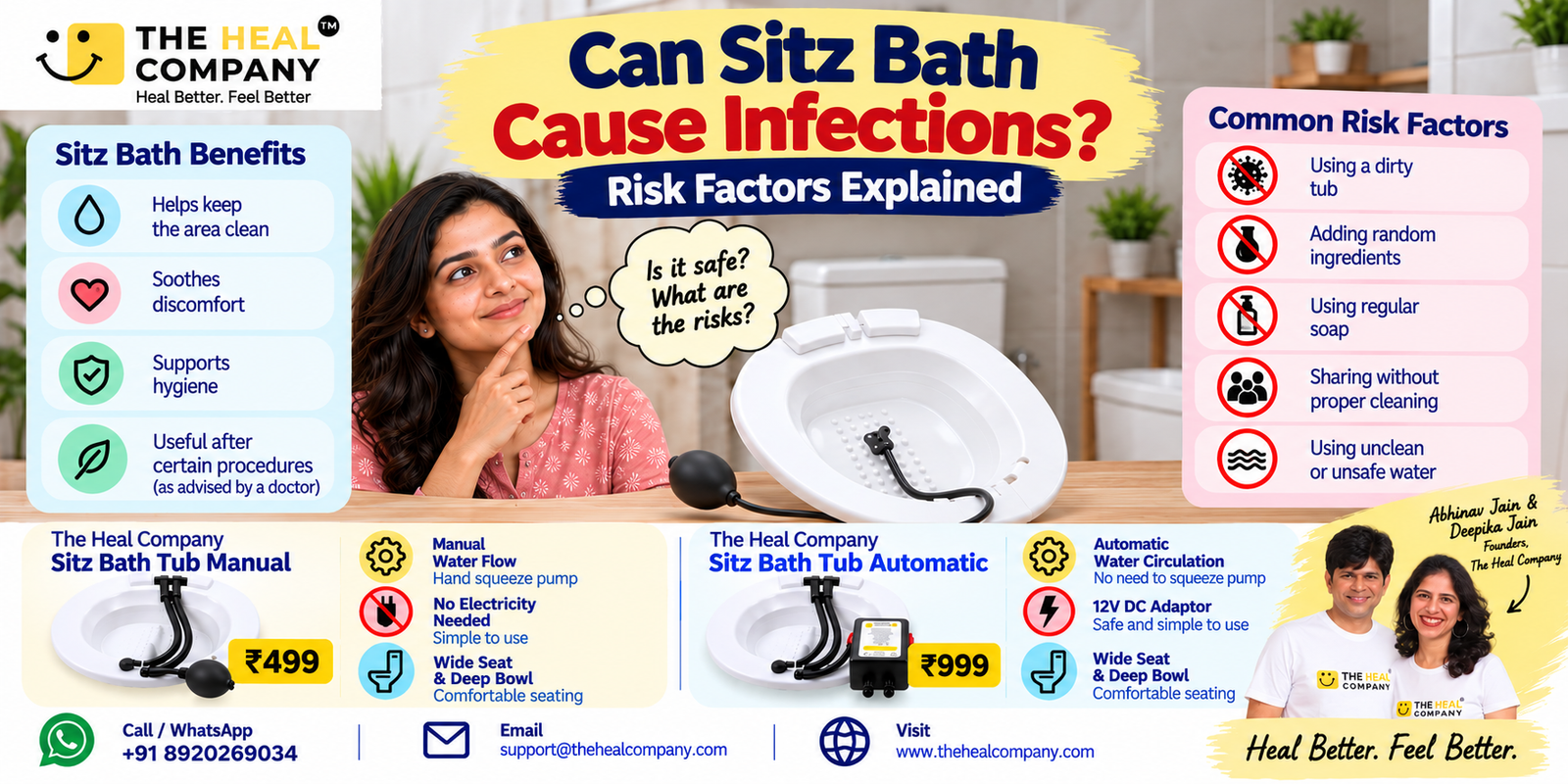
Can a Sitz Bath Actually Cause an Infection?
I wouldnt say that using a sitz bath normally causes infection.
In fact, there are medical situations where sitz baths are specifically used to help keep the perianal area clean. A 2026 hospital guide for some patients at high risk of perianal infection describes sitz baths as part of their infection-prevention care. That is a special medical protocol, though, and should not be copied at home without medical advice.
The problem is usually how the tub is handled.
Think about your drinking glass.
Water in a clean glass is one thing.
Water in a glass that has been sitting dirty for days is another.
Your sitz bath deserves the same basic thinking.
Risk Factor 1: Using a Dirty Sitz Bath Tub
This is probably the first thing I would check.
After using a sitz bath, dont just empty the water and leave the wet basin beside your toilet until tomorrow.
Clean it according to the product instructions.
Rinse it.
Then let it dry properly.
A good routine is:
Use → Empty → Clean → Rinse → Dry → Store
Postpartum medical guidance, for example, specifically advises cleaning a bathtub before bathing and keeping the affected area clean and dry. MedlinePlus
Risk Factor 2: Not Washing Your Hands
Your hands touch the tub.
They may touch the pump, pipe or other parts.
So start with clean hands.
And wash your hands again after you’re finished.
It takes very little time.
For me, this should become part of the sitz bath routine, just like washing your hands before handling food.
Risk Factor 3: Sharing the Tub Without Cleaning It
I personally prefer keeping a sitz bath as an individual-use product when possible.
If more than one person is going to use the same basin, it should be properly cleaned and dried between users.
Dont simply empty somebody else’s water, refill the basin and use it again.
That isnt a hygiene habit I would recommend.
Risk Factor 4: Storing the Tub While It Is Wet
This is another small mistake.
You finish your sitz bath.
You rinse the tub.
Then you immediately put it into a storage bag or closed cupboard while water is still sitting on it.
I wouldnt do that.
Let the tub dry properly before storing it.
The same idea applies to the pipe and pump area where applicable.
Clean and dry should go together.
Risk Factor 5: Using Questionable Water
Use clean water suitable for bathing.
If you’re travelling somewhere and you’re not comfortable with the water quality, deal with that question before preparing your sitz bath.
People may use our products in Delhi, Jaipur, Lucknow, Mumbai, Ahmedabad, Bengaluru, Chennai, Hyderabad or many smaller Indian cities, but the basic rule stays the same.
Start with clean equipment and suitable water.
Risk Factor 6: Adding Random Things to the Water
This one comes up again and again.
Salt.
Epsom salt.
Essential oils.
Antiseptic liquid.
Soap.
Apple cider vinegar.
Herbal mixtures.
Please dont assume that adding something makes your sitz bath cleaner or more powerful.
For routine postpartum hygiene, for example, NHS guidance recommends plain warm water and careful drying, and some guidance specifically advises against soap or salt on healing areas.
There are special medical situations where clinicians prescribe an antiseptic solution in a sitz bath, but that is a specific medical protocol, not a general home recipe.
If your doctor has told you to add something, follow their directions.
Otherwise, dont experiment on sensitive skin.
Risk Factor 7: Not Drying Yourself Properly
Cleaning is only half the job.
After the sitz bath, gently dry the area according to the medical advice you’ve been given.
Dont rub sore skin hard.
Postpartum guidance commonly recommends gently patting the area dry with a clean towel and keeping it clean and dry.
This is such a small step, but I feel people sometimes rush it.
Risk Factor 8: Using a Sitz Bath When Your Doctor Said Not To
A sitz bath can be useful supportive care, but it isnt right for every wound or every stage of recovery.
For example, guidance following some surgical wounds advises people not to soak until the wound has healed because keeping that particular wound dry helps reduce infection risk.
So after surgery, dont assume:
“Sitz bath is good for recovery, so I should use it.”
Ask your doctor or surgical team when you can start.
Their advice comes before a blog post or product instructions.


Sitz Bath Tub Manual
₹1,499.00 Original price was: ₹1,499.00.₹499.00Current price is: ₹499.00.
What Are Signs That I May Have an Infection?
Dont use a sitz bath to hide a problem that needs medical attention.
Depending on the condition or wound, warning signs can include increasing pain, worsening redness or inflammation, unpleasant-smelling discharge, or fever. Medical guidance for postpartum wounds, for example, advises getting medical help if an area becomes increasingly painful, looks inflamed or develops an unpleasant smell.
If something feels wrong, contact a healthcare professional.
A sitz bath is supportive care. It isnt an infection treatment unless a clinician has given you a specific medical protocol.
The Heal Company – Sitz Bath Tub Manual
Our The Heal Company – Sitz Bath Tub Manual costs ₹499.
It is made from durable BPA-free plastic and has a wide comfort seat and deep bowl.
The Manual model has a hand squeeze pump.
One continuous pipe connects the hand pump to the water-flow nozzle inside the basin.
You squeeze the pump by hand to create gentle water movement.
No electricity is required.
For hygiene, I like keeping the routine simple:
Clean hands → Clean tub → Fresh warm water → Use → Empty → Clean → Dry completely → Store
That is much better than making the process complicated.
What About The Automatic Version?
Our The Heal Company Automatic Sitz Bath Tub costs ₹999.
It includes:
1 Plastic Sitz Bath Tub, 1 Motor Box with 2 connected pipes and nozzles, 1 12V DC Adaptor, 1 Storage Bag and 1 Instruction Manual.
One nozzle draws water from the basin.
The second provides upward water flow.
Because this model has electrical components, there is one extra rule:
Keep the motor box and adaptor dry.
Never immerse them in the bath water.
After use, clean the washable parts according to the supplied instructions and only store the equipment once it is properly dry.
What About Sitz Baths After Childbirth?
This is one area where hygiene matters a lot.
After childbirth there may be soreness, stitches or an episiotomy.
Medical guidance recommends keeping stitches and the surrounding area clean and dry. Plain warm water is commonly advised, while unnecessary soaps and other products may irritate the area.
Follow your maternity team’s instructions because every recovery can be different.
If you notice worsening pain, unpleasant smell, fever or other signs that worry you, speak with your midwife or doctor rather than simply taking more sitz baths.
Can Sitz Baths Prevent Infection?
I would be careful with that sentence.
A sitz bath can help with cleaning and hygiene, and special medical protocols sometimes use sitz baths as part of infection-prevention care.
But that does not mean an ordinary home sitz bath guarantees that you wont get an infection.
That would be too big a claim.
Think of the sitz bath as a tool.
How you clean it, how you use it, and whether it is suitable for your condition all matter.
Sitz Bath Tub Manual
₹1,499.00 Original price was: ₹1,499.00.₹499.00Current price is: ₹499.00.
My Simple Hygiene Rule
Deepika and I like simple instructions.
So if you remember nothing else from this article, remember this:
Clean tub. Clean hands. Fresh warm water. Gentle use. Proper drying.
And if you’re recovering from childbirth or surgery, or you already have an infection, follow your healthcare professional’s instructions.
Dont try to turn a home-care product into a replacement for medical treatment.
A Note From Abhinav & Deepika
At The Heal Company, our work is around designing products that support comfort and home care.
But making a product is only one part of the job.
Teaching people to use it safely matters too.
That is why I dont want somebody buying The Heal Company – Sitz Bath Tub Manual and thinking more ingredients, hotter water or longer soaking automatically means better results.
Often, simple is better.
Heal Better. Feel Better.
The Heal Company – Sitz Bath Tub Manual: ₹499
The Heal Company Automatic Sitz Bath Tub: ₹999
Founders: Abhinav Jain & Deepika Jain
Email: support@thehealcompany.com
Call / WhatsApp: +91 8920269034
Website: TheHealCompany.com
If you call, one of us — Abhinav Jain or Deepika Jain — will pick up your call, so feel free to call and clear your questions.
Heal Better. Feel Better.
-
Sitz Bath Tub Manual
Rated 4.95 out of 5₹1,499.00Original price was: ₹1,499.00.₹499.00Current price is: ₹499.00.