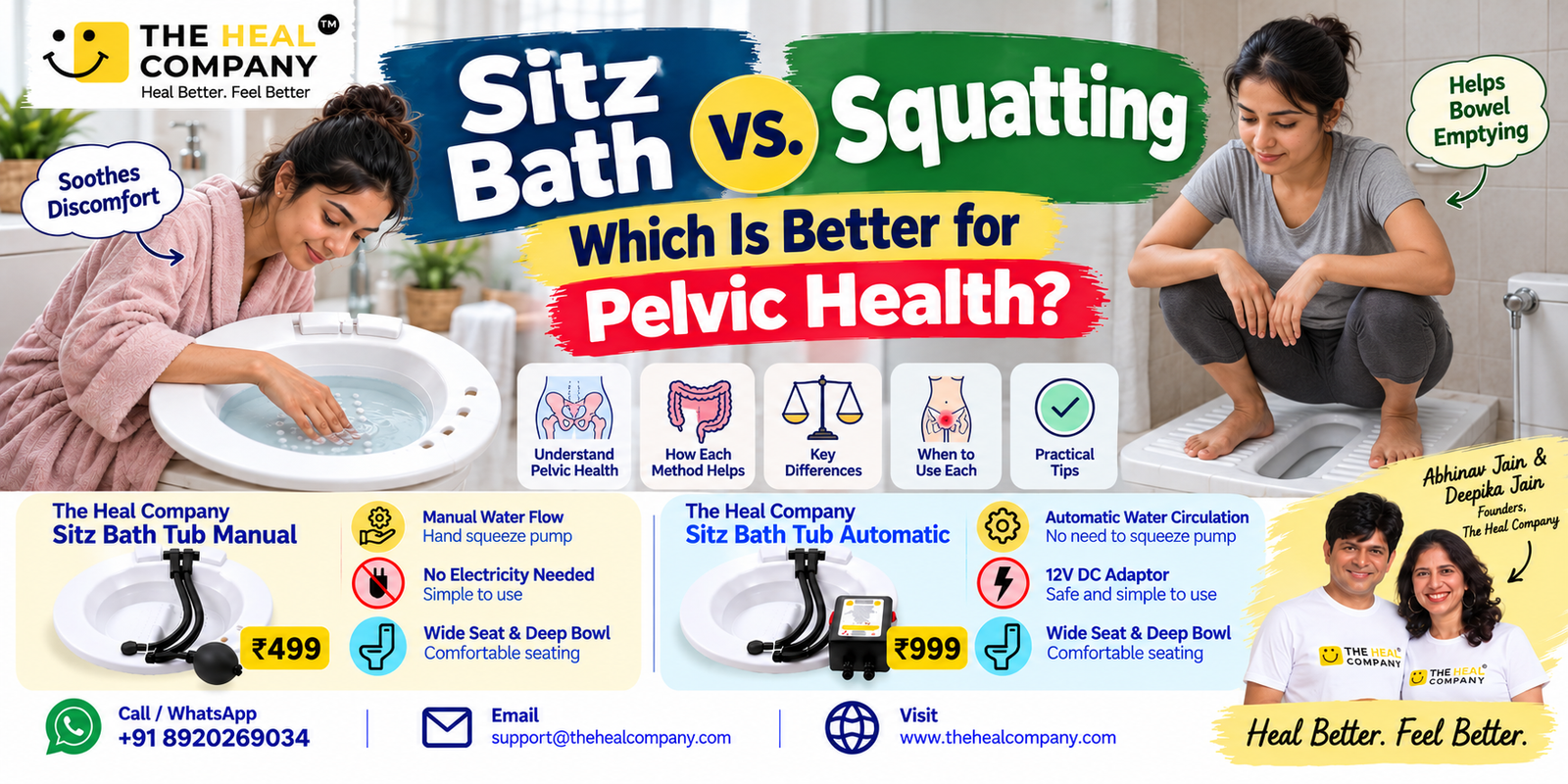
By Abhinav Jain, Founder – The Heal Company
Heal Better. Feel Better
You have been using an Indian-style toilet for years. Now someone tells you that squatting is good for your pelvic health. Another person says sitting in warm water is better.
So which one is right?
And can squatting actually help with piles, constipation or pain around your bottom?
I find this comparison interesting because a sitz bath and squatting are two very different things. Still, people often connect them because both involve the same part of our body.
I am Abhinav Jain, co-founder of The Heal Company, a Delhi-based brand started by me and Deepika Jain. We design products that make home care easier, especially for people dealing with discomfort in sensitive areas.
While working on our sitz bath products, I realised how much the type of toilet we use matters. Some homes have Indian toilets, some have Western toilets, and many families have both.
But does the way you sit or squat really change your pelvic health?
Let’s talk about it.
First, What Is Pelvic Health?
Your pelvis is the lower part of your body, around your hips.
Inside this area are your bladder, bowel and other organs.
There are also muscles called the pelvic floor muscles. Think of them like a small hammock holding things in place.
These muscles help you control urine and stool. They also relax when you need to empty your bowel.
When these muscles don’t work properly, you may have trouble passing stool, urine leakage, pelvic pain or a feeling of pressure.
But all these problems don’t have the same cause.
And one toilet position cannot fix every pelvic problem.
Why Do People Say Squatting Is Better?
If you grew up in India, you probably know what an Indian-style toilet looks like.
You bend your knees, lower your body and squat.
This position changes the angle between your rectum and anus. For some people, it may make passing stool easier.
There are small studies suggesting that squatting can reduce straining or help bowel emptying compared with ordinary upright sitting.
But the research is limited.
It does not prove that squatting is better for every person’s pelvic floor.
And it certainly doesn’t mean you should start squatting if you have knee pain, poor balance or have recently undergone surgery.
I would never suggest forcing your body into a position that hurts.
What if You Have a Western Toilet?
You don’t need to change your toilet just to improve your bowel position.
If you use a Western toilet, placing your feet on a stable, low footstool may help.
Your knees should be a little higher than your hips.
Lean forward slightly, rest your elbows on your thighs and try to relax.
Don’t hold your breath and push hard.
For somebody living in Rohini, Delhi, or Baner, Pune, who uses a Western toilet every day, this may be easier than trying to squat.
And if you are having trouble passing stool, don’t sit there for 20 minutes scrolling through your phone.
Get up and try again later.
Now, What Does a Sitz Bath Have to Do With Pelvic Health?
A sitz bath is not a toilet position.
It means sitting in comfortably warm water so the area around your anus and private parts gets soaked.
People often use sitz baths for soreness caused by piles, anal fissures or discomfort after childbirth, when recommended by a healthcare professional.
The warm water may help relax the muscles around the anal area and soothe irritation.
But a sitz bath does not train your pelvic floor muscles.
It also does not correct pelvic organ prolapse, cure urine leakage or fix chronic constipation.
This is why I don’t think squatting and sitz baths should be treated as two competing treatments.
They have different jobs.


Sitz Bath Tub Manual
₹1,499.00 Original price was: ₹1,499.00.₹499.00Current price is: ₹499.00.
Sitz Bath vs. Squatting: What’s the Real Difference?
| Squatting or supported toilet posture | Sitz bath | |
|---|---|---|
| Main purpose | Helps with body position while passing stool | Provides warm-water soaking |
| Possible benefit | May make bowel emptying easier for some people | May soothe soreness and irritation |
| Useful for | Some people who strain during bowel movements | Some people with piles, fissures or perineal discomfort |
| Does it cure piles? | No | No |
| Does it strengthen pelvic floor muscles? | Not by itself | No |
| Main concern | Joint pain, balance and straining | Water temperature, hygiene and safe seating |
If somebody asks me which is better, my answer would depend on what they are trying to improve.
If the problem is hard stool, a better toilet position may help a little.
If the problem is soreness after passing stool, a warm sitz bath may feel good.
If the problem is pelvic floor weakness, neither one is a full treatment.
Can Squatting Make Piles Worse?
This is where people get confused.
Squatting itself is not proven to cause piles.
But pushing hard while passing stool can increase pressure around the anus.
And that can make hemorrhoid symptoms worse.
So whether you use an Indian toilet or a Western toilet, try not to strain.
I feel people spend too much time debating which toilet is better, while forgetting the simple things.
Are you drinking enough water?
Are you eating enough fibre?
Are you ignoring the urge to pass stool?
These things matter.
For somebody in Jaipur, Hyderabad or Kolkata who has constipation every morning, changing toilet position alone may not solve the problem.
Why We Developed The Heal Company – Sitz Bath Tub Manual
Let me share the thinking behind our product.
Many Indian homes don’t have a bathtub. And when a doctor suggests a sitz bath, people start wondering how they will manage it.
A big bucket isn’t always safe to sit in.
And filling a full bathtub every day isn’t practical for many families.
That is one reason Deepika and I focused on a toilet-mounted sitz bath basin.
The Heal Company – Sitz Bath Tub Manual is designed to fit compatible Western toilets.
It has a wide comfort seat, a deep bowl and a hand-operated water pump.
A grey pipe connects the hand pump to the nozzle inside the tub. You squeeze the pump to move water through the nozzle.
There is no electricity needed.
The Manual Sitz Bath Tub costs ₹499.
I like this version because it keeps the process simple.
Fill the basin with comfortably warm water, place it securely on a compatible toilet, and use it as instructed.
But please check the fit before sitting. Not every Western toilet has the same shape.
And if your home has only an Indian-style squat toilet, this product should not be balanced over it.
What About The Heal Company Automatic Sitz Bath Tub?
We also make an Automatic Sitz Bath Tub priced at ₹999.
The Automatic version uses a small motor for water circulation.
You don’t need to keep squeezing the hand pump.
It comes with a sitz bath tub, motor unit with connected pipes and nozzles, adaptor, storage bag and instruction manual.
The motor unit and adaptor must stay dry.
Now, does the Automatic version improve pelvic health more than the Manual one?
No such benefit has been established.
The difference is convenience, not a promise of better medical results.
If you prefer a simple product without electricity, I would suggest the ₹499 Manual version.
If you want powered water movement, the ₹999 Automatic version may suit you.
Sitz Bath Tub Manual
₹1,499.00 Original price was: ₹1,499.00.₹499.00Current price is: ₹499.00.
How to Take a Sitz Bath Safely
If your doctor has advised a sitz bath, use clean, comfortably warm water.
Not very hot water.
Sit for around 10 to 15 minutes, or for the duration recommended by your doctor.
You don’t need to add antiseptic liquid, soap or essential oils unless specifically advised.
After soaking, gently pat the area dry.
Clean the tub after every use.
And if sitting causes pain, stop and ask your healthcare professional for advice.
A sitz bath should feel comfortable. It should not leave your skin burning or irritated.
What About Pelvic Floor Exercises?
If your problem is urine leakage or pelvic floor weakness, you may need something different.
Pelvic floor exercises can help certain problems, but they need to be done correctly.
And if your pelvic floor muscles are already too tight, doing more squeezing exercises may not help and can sometimes make symptoms worse.
That is why I would suggest seeing a doctor or pelvic floor physiotherapist if you have ongoing pelvic pain, difficulty emptying your bladder or bowel, or urine leakage.
You can learn more about bowel health and constipation from the National Institute of Diabetes and Digestive and Kidney Diseases and read about pelvic floor exercises on the NHS website.
So, Which One Would I Choose?
I wouldn’t choose one over the other without knowing the problem.
For passing stool, I would focus on a comfortable toilet position, softer stools and less straining.
For soreness around the anus, I would consider warm-water soaking if appropriate for the condition.
And for a pelvic floor problem, I would get proper medical advice instead of expecting a sitz bath or squatting to fix it.
That’s how I see it.
At The Heal Company, we want to make simple home care easier. Our products are meant to support comfort and recovery, not replace medicines or medical treatment when needed.
If you have questions about choosing a sitz bath tub, toilet compatibility or how our products work, please contact us.
If you call, one of us — Abhinav Jain or Deepika Jain — will pick up your call. Feel free to ask your questions before placing an order.
The Heal Company – Sitz Bath Tub Manual: ₹499
The Heal Company – Sitz Bath Tub Automatic: ₹999
Website: https://thehealcompany.com
Email: support@thehealcompany.com
Call / WhatsApp: +91 8920269034
The Heal Company — Heal Better. Feel Better.
-
Sitz Bath Tub Manual
Rated 4.95 out of 5₹1,499.00Original price was: ₹1,499.00.₹499.00Current price is: ₹499.00.